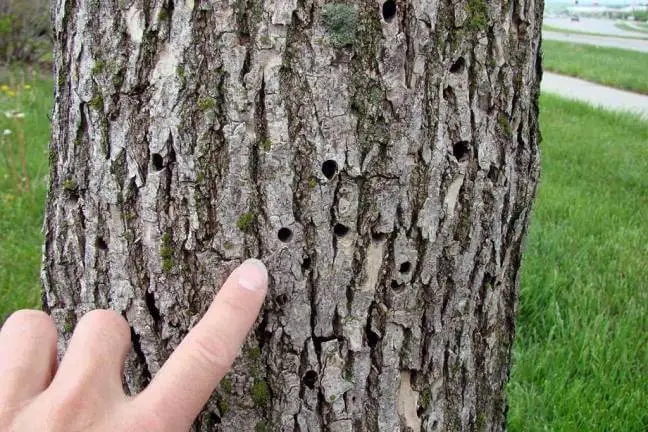
The Emerald Ash Borer (EAB) is an invasive beetle that kills ash trees. Since its first detection in Michigan in 2002, it has spread across more than 35 states and killed hundreds of millions of ash trees. Scientists have called it “the most destructive and economically costly forest insect to ever invade North America.”
Why EAB Is So Destructive
Without a natural predator on this continent, EAB populations explode wherever ash trees grow. The adult beetles are small — roughly half an inch long with a metallic green shell — and cause only minor leaf damage. The real destruction comes from the larvae. After eggs hatch beneath the bark, larvae feed on the phloem and sapwood, the tissues that carry water and nutrients throughout the tree. A heavily infested ash can have thousands of larvae tunneling S-shaped galleries under the bark at the same time, effectively choking off the tree’s circulatory system. Most untreated trees die within two to four years of the initial infestation.
Signs of an EAB Infestation
Routine inspection and monitoring of your trees helps ensure early detection. While the insect itself is small and difficult to spot, there are visible warning signs every Chicago-area homeowner should watch for:
- D-shaped exit holes in the bark, roughly 1/8 inch across — these are left by emerging adult beetles.
- S-shaped larval galleries visible when bark peels away.
- Canopy thinning that begins at the top of the tree and progresses downward over successive seasons.
- Epicormic shoots — clusters of new sprouts growing from the trunk or large branches, which the tree produces in a desperate attempt to replace lost foliage.
- Increased woodpecker activity — woodpeckers feed on EAB larvae and often strip bark in infested areas.
Treatment Options
The most effective treatment for EAB is a systemic insecticide — typically containing emamectin benzoate — that is injected directly into the trunk. The tree distributes the product through its vascular system, killing larvae as they feed. Treatments are typically applied every two to three years and are most successful when started before the tree has lost more than half its canopy. Soil drenches with imidacloprid are another option for smaller trees and can be applied as a preventive measure before any symptoms appear.
How Greener Living Can Help
At Greener Living, we have tree care professionals on staff who can inspect your ash trees, diagnose the level of infestation, and recommend the right treatment plan. Early intervention is the key — once canopy loss exceeds 50 percent, saving the tree becomes much more difficult and costly. If you suspect your ash trees may be affected, contact us at 224-415-3698 or request a free estimate to schedule a tree care appointment right away.